PFAS “forever chemicals” policies lead in 2026
Nearly everyone in the United States has PFAS “forever chemicals” in their bodies. These persistent toxic chemicals contaminate food, drinking water, farmland, and everyday products, and do not break down in the environment.
States are responding with class-based restrictions, disclosure requirements, and cleanup programs. While retailer commitments and earlier state policies have reduced some uses, PFAS contamination remains widespread.
Why PFAS “forever chemicals” matter
PFAS, or per- and polyfluoroalkyl substances, are used in both manufacturing and finished products such as cookware, food packaging, carpets, clothing, firefighting foams, and industrial processes. They are known as “forever chemicals” because of their remarkable persistence and mobility—they do not break down in the environment and can move through soil to contaminate drinking water, making them global pollutants.
Scientific research links exposure to weakened immune systems, cancer, reproductive harm, and other serious health harms. The extremely low federal drinking water standards finalized in 2024 underscore their high toxicity. State leadership is increasingly critical as federal implementation of those drinking water standards remains uncertain.
Defining PFAS scientifically
Currently, 24 states have adopted a common, scientifically grounded definition of the class of forever chemicals. However, some PFAS manufacturers and users have attempted to weaken protections by narrowing the definition in ways that would exclude certain widely used PFAS, including PFAS plastic (referred to as fluoropolymers) and fluorinated gases.
Chemical industry-backed efforts to weaken PFAS regulations are likely to continue in 2026.
Anticipated PFAS policy and regulations
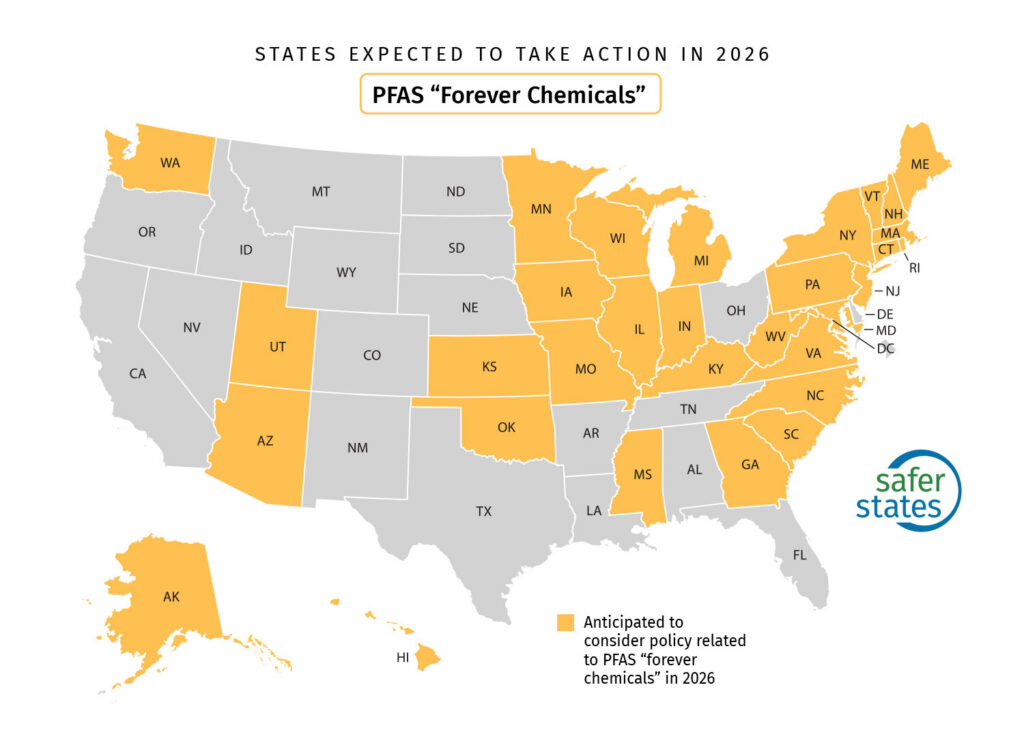
In 2026, at least 31 states will likely consider policies addressing forever chemicals, ranging from bans in products to water standards, sludge spreading restrictions, and cleanup funding. These states include Alaska, Arizona, Connecticut, Georgia, Hawaii, Illinois, Indiana, Iowa, Kansas, Kentucky, Maine, Maryland, Massachusetts, Michigan, Minnesota, Mississippi, Missouri, New Hampshire, New Jersey, New York, North Carolina, Oklahoma, Pennsylvania, Rhode Island, South Carolina, Utah, Vermont, Virginia, Washington, West Virginia, and Wisconsin.
Prevention-based policies
